



An electronic newsletter for the science education community
DeBoer Explains Science Education’s Great Debates
The notion of controversy in the science classroom might bring to mind debates about the teaching of evolution and or about mandatory testing under No Child Left Behind. But focusing on such high-profile concerns misses larger tensions that have characterized science education in the U.S. over the past century. Taking a long view of science education reveals the competing approaches to what and how students should learn in science that have shaped today’s K–12 science landscape.
-
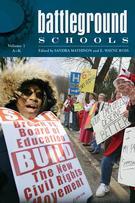
Battleground: Schools
George DeBoer, Project 2061’s deputy director, provides that long view in his coverage of “Science Education” for a new resource from Greenwood Press. Battleground: Schools provides balanced overviews of 100 conflicts involving education issues today. The book aims to help teachers, students, and parents to better understand the foundations of such controversial topics as charter schools, distance education, home schooling, religion and public schools, and students’ rights.
DeBoer's look at science education traces how traditional and progressive ideals have competed with each other in science education. The two approaches have shaped debates over “child-centered vs. teacher-centered teaching; disciplinary knowledge vs. societal applications; and discovery vs. reception learning” (DeBoer, 2007). DeBoer covers four key periods in the history of science education: (1) the progressive era of the first half of the twentieth century; (2) the age of reform in the 1950s and 1960s, characterized by an intellectual treatment of the scientific disciplines; (3) the shift in the 1970s away from disciplinary study and toward social relevance in the form of science literacy; and (4) the past two decades focusing on goal statements in science education through documents such as Project 2061's Science for All Americans (AAAS, 1989) and the National Research Council's National Science Education Standards (NRC, 1996).
Read the complete DeBoer article.
See details and ordering information for Battleground: Schools.
# # #
For more information, please contact:
Deputy Director: Dr. George DeBoer, (202) 326-6624
References
American Association for the Advancement of Science. (1989). Science for all Americans. New York: Oxford University Press.
DeBoer, G. E. (2007). Science education. In S. Mathison & E. W. Ross (Eds.), Battleground: Schools [Two Volumes] (pp. 556–562). Westport, CT: Greenwood Press.
National Research Council. (1996). National science education standards. Washington, DC: National Academy Press.
Also in the March/April 2008 issue: